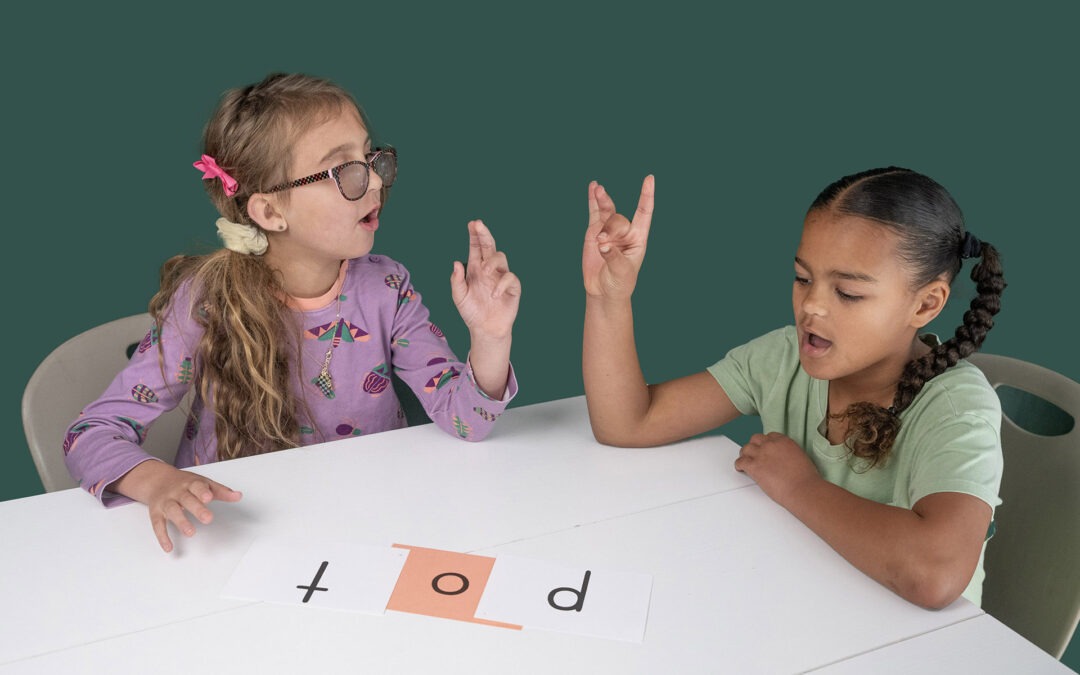
For years, reading instruction often treated phonics and vocabulary as separate entities. Young readers were taught to decode simple words according to phonics rules, while rich vocabulary and morphology work was reserved for older students or oral read-alouds. However, as Dr. Maryanne Wolf emphasized in her landmark 2025 paper, Elbow Room: How the Reading Brain Informs the Teaching of Reading, the development of deep reading requires an intentional bridge between foundational skills and language comprehension.
Further, Duke and Cartwright’s 2021 model of The Active View of Reading positions Vocabulary Knowledge and Morphological Awareness as bridging processes between Word Recognition and Language Comprehension for greater decoding, comprehension, and reading efficiency.
Rather than viewing decoding and vocabulary as competing priorities, young children benefit from intentional, purposeful instruction in vocabulary and morphology, in tandem with phonics-based decoding strategies and practice. In this way, teachers support orthographic mapping, which leads to faster word recognition and enhances the development of fluency from an early age.
To orthographically map a word, you must attend to its sound components, its visual representation (spelling), and its meaning. In the early grades, it is easy to focus on the phoneme-grapheme connection in reading and spelling; however, it is crucial to embed meaning in instruction to promote vocabulary development, word recognition, and fluency.
“It is insufficiently emphasized that the more one knows about a word, the faster and better the word is read and understood. This too-little-known dimension of SOR has important implications for multilingual readers who may have less knowledge about English words to bring to decoding. The more all our children know about how the English language works, the better all reading will be at word and connected text levels.” (Wolf, 2025)
Enter the POSSUM Strategy
The POSSUM strategy is a multi-linguistic framework that engages all language processing systems involved in word reading. This strategy can be used across grade levels, during foundational skills lessons or during knowledge-building read-alouds. When implemented with purpose in the early grades, the POSSUM strategy builds rich vocabulary, word recognition, and reading fluency.
What is the POSSUM Strategy?
POSSUM is a mnemonic that engages all language processing systems involved in word reading. It is a framework for you, as a teacher, to consider the words in your scope and sequence, and a tool for your students to use to strengthen their word recognition and comprehension.
The Mnemonic
- P – Phonology: What does the word sound like? (Phoneme segmentation, blending)
- O – Orthography: How is the word spelled? What are the letter patterns or syllable types?
- S – Syntax: What part of speech is it, and how does it function in a sentence?
- S – Semantics: What does the word mean? (Including multiple meanings)
- U – Understanding: How does this connect to prior knowledge or real-world experiences?
- M – Morphology: What are the meaningful word parts? How else might you see or use the word? (prefixes, suffixes, base words)?
By mapping a word across all six dimensions, students create robust, fully specified orthographic mappings in the brain, accelerating both word recognition speed (fluency) and comprehension.
Integrating POSSUM into Your Decodable Scope & Sequence
So what does this look like in the classroom? And can K-2 students handle this strategy?
Absolutely. In fact, highly decodable, early-grade words are prime candidates for POSSUM—especially multiple-meaning words that young children frequently encounter.
Want to try it out with your students? Use our POSSUM Planning Guide and Graphic Organizer.
Take the word “bog,” for example. This simple CVC word is often used in decodable passages for short o. However, students might not be familiar with it as a noun or a verb. Or the word “scarf,” perhaps later on in a first- or second-grade scope and sequence focused on r-controlled vowels. Check out the breakdown below.
Example 1: “bog” (short o closed syllable)
- Phonology: 3 sounds — /b/ /ŏ/ /g/
- Orthography: b-o-g, 1 closed syllable, CVC spelling
- Syntax: noun (The frog jumped into the bog.) or verb (Don’t get bogged down.)
- Semantics: wet, spongy ground or muddy swamp; or to get stuck or feel weighed down
- Understanding: Have you ever walked in mud that pulled your shoe off? That’s like a bog!
- Morphology: base word: bog; related forms: bogs, bogged, boggy (-y suffix)
Example 2: “scarf” (consonant blend + r-controlled ar)
- Phonology: 4 sounds — /s/ /k/ /ɑr/ /f/
- Orthography: s-c-a-r-f, r-controlled vowel (ar), initial sc blend
- Syntax: noun (She wore a warm scarf) or verb (She scarfed her dinner down after soccer practice.)
- Semantics: a piece of cloth worn around the neck; or to eat something quickly
- Understanding: What do you wear on cold winter days? How do you eat when you are starving?
- Morphology: base word: scarf; irregular plural: scarves; verb: scarfing, scarfed
How POSSUM Drives Fluency and Vocabulary Growth
When you attend more critically to all aspects of language processing, even at the CVC level, your students will strengthen their orthographic mapping of key phonics concepts, build vocabulary, and promote fluency development. Using the POSSUM strategy with your students will:
- Prevent Over-Reliance on Visual Guessing: POSSUM forces students to look closely at phonemes and graphemes (P & O) before jumping into contextual meaning.
- Solidify Multiple-Meaning Words: Early readers often get confused when a simple decodable word changes meaning based on syntax. POSSUM makes syntactic shifts explicit (S & S).
- Build Morphological Awareness Early: Introducing simple suffixes like -ed, -s, or -y during the M step prepares students for multisyllabic reading later on.
Try the POSSUM strategy out with your students with our FREE Teacher Planning Guide and Student Graphic Organizer. You can easily incorporate this into your existing curriculum. Teaching Magic E with a-e next week? Try it out with the word “scale.”
POSSUM Teacher Planning Guide and Student Graphic Organizer.
Learn more about how to use this tool during our free virtual workshop, Playing POSSUM? Vocabulary and Fluency Strategies for K-2 on Thursday, September 10, 2026, 4- 5 p.m.
References:
Duke, N. K., & Cartwright, K. B. (2021). The science of reading progresses: Communicating advances beyond the Simple View of Reading. Reading Research Quarterly, 56(S1), S25–S44. https://ila.onlinelibrary.wiley.com/doi/full/10.1002/rrq.411
Heinemann. (2025, April 9). What is the Active View of Reading? Heinemann Blog. https://www.heinemann.com/blog/what-is-the-active-view-of-reading
Wolf, M. (2025). Elbow room: How the reading brain informs the teaching of reading. Albert Shanker Institute. https://www.shankerinstitute.org/issues/literacy/elbow-room