Chartwell’s occupational therapists, Lisa Benjamin, and Katlyn Bach, share their insight into how occupational therapy can be used both in and out of the classroom. Their strategies for success, from the occupational therapy lens, include screen-free activities that are both fun and functional, tips for using flexible seating that is optimal for students’ profiles, and how to engage in productive playtime that promotes social interaction. Find three of their most valuable resources for integrating occupational therapy in the classroom below.
Lisa’s Strategies for Success
Occupational therapy (OT) not only happens during individual treatment sessions, it occurs daily in the classroom! One of the main occupations of a child is to learn and this can be done through play. Students are working to develop skills in problem-solving, fine and gross motor, visual perceptual, and visual motor throughout their school day. While these skills are addressed through academics at times, children are more motivated and engaged when playing with peers. Try some of these screen-free activities during breaks of instruction (ie: rainy day recess, “free time”, etc) to promote development and social interaction. For example: having a student complete a dot-to-dot instead of just free coloring allows students to draw while also working on fine motor precision, sequencing, focused attention, and visual tracking. Or try a game like Blink!, where students can interact with 2-3 peers in a more structured way and work on skills like visual discrimination, fine motor, impulse control, and eye-hand coordination. Play is always FUNctional!
Katlyn’s Strategies for Success
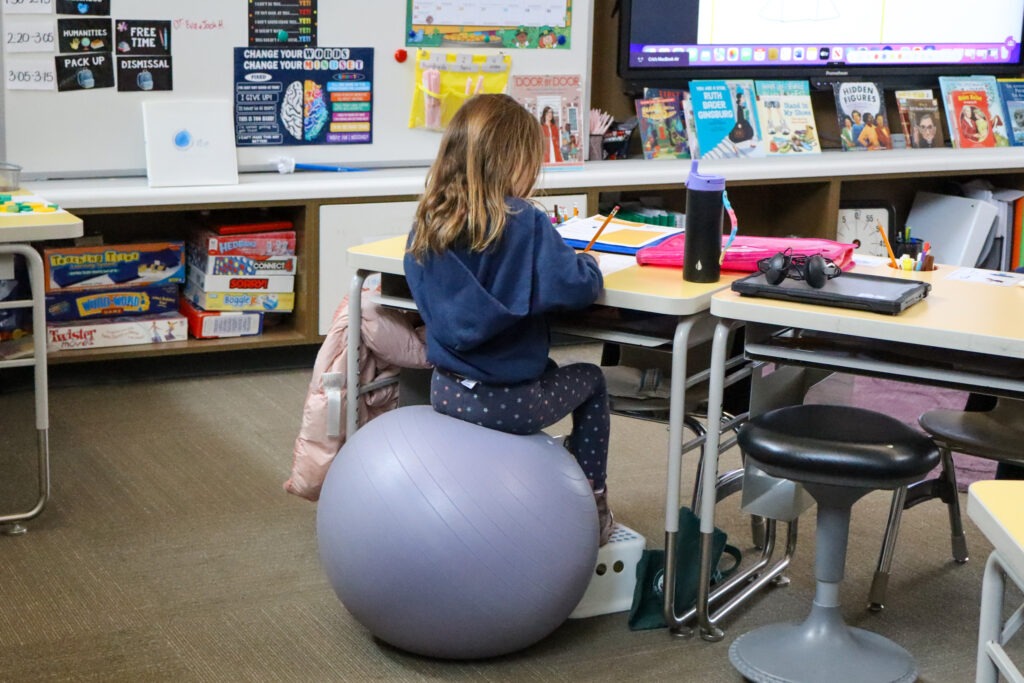
Another key piece of incorporating OT concepts into the classroom is meeting the students’ physical needs while they are at their desks. Here are some things to look for to help ensure your student is sitting in optimal seating for them.
Regardless of the student or the seating arrangement, their feet should be able to firmly touch the floor or a stable surface. This is important not just for comfort, but also in providing support to help them engage their core and sit upright.
While flexible seating can keep things fun and help our more wiggly students there are a few things to consider first:
- Do they have poor body awareness? If so, a wobble stool or a yoga ball may not be a good choice as they may fall or leave their space. Try a wobble disc. rocking chair, or a yoga ball chair with a stable base.
- Do they have poor core strength (slouch often, prop their head on their heads frequently)? If so they should be sitting in a chair with a back, but consider a rocking chair, wobble disc, or kick band.
- Do they need a sitting arrangement to help lower their energy? Deep pressure can be calming so you may consider allowing them to lay on the floor with a clipboard or sitting against a floor pillow or on a beanbag with a lap desk or slant board.
Resource Recommendations
Toolbox: Flexible Seating in the Classroom
Podcast: All Things Sensory – Sensory Strategies for EVERY Classroom
Resource List: Non-Tech Options for Free Time
Lisa Benjamin is an occupational therapist at Chartwell School. She holds a Master of Science in Occupational Therapy from San Jose State University and a Bachelor of Science in Exercise Science from Fresno State. She has a dual elementary education and mild/moderate special education credential. Lisa has worked at Chartwell for 5 years as the lead occupational therapist and previously worked in a pediatric outpatient setting. Prior to Chartwell, Lisa was a Resource Specialist and case manager for 5 years in a middle school in Sanger, CA. In addition to overseeing executive functioning at Chartwell, being an instructional coach, and providing individualized OT services to small groups of students (1st-12th grade), she provides instructional workshops to teachers and families that focus on sensory processing, classroom accommodations, executive functioning, social-emotional learning, driver readiness, and fine and visual motor skills.
Katlyn Bach is an occupational therapist at Chartwell School. She has a Bachelor of Arts in Psychology from Fresno State and a Master of Science in Occupational Therapy from San Jose State. She has a focus on the pediatric population with experience serving children within both private and public schools, home settings, and pediatric clinics. She is passionate about uplifting educators and incorporating play and creativity within the classroom to help facilitate students’ growth and confidence.